Who we help
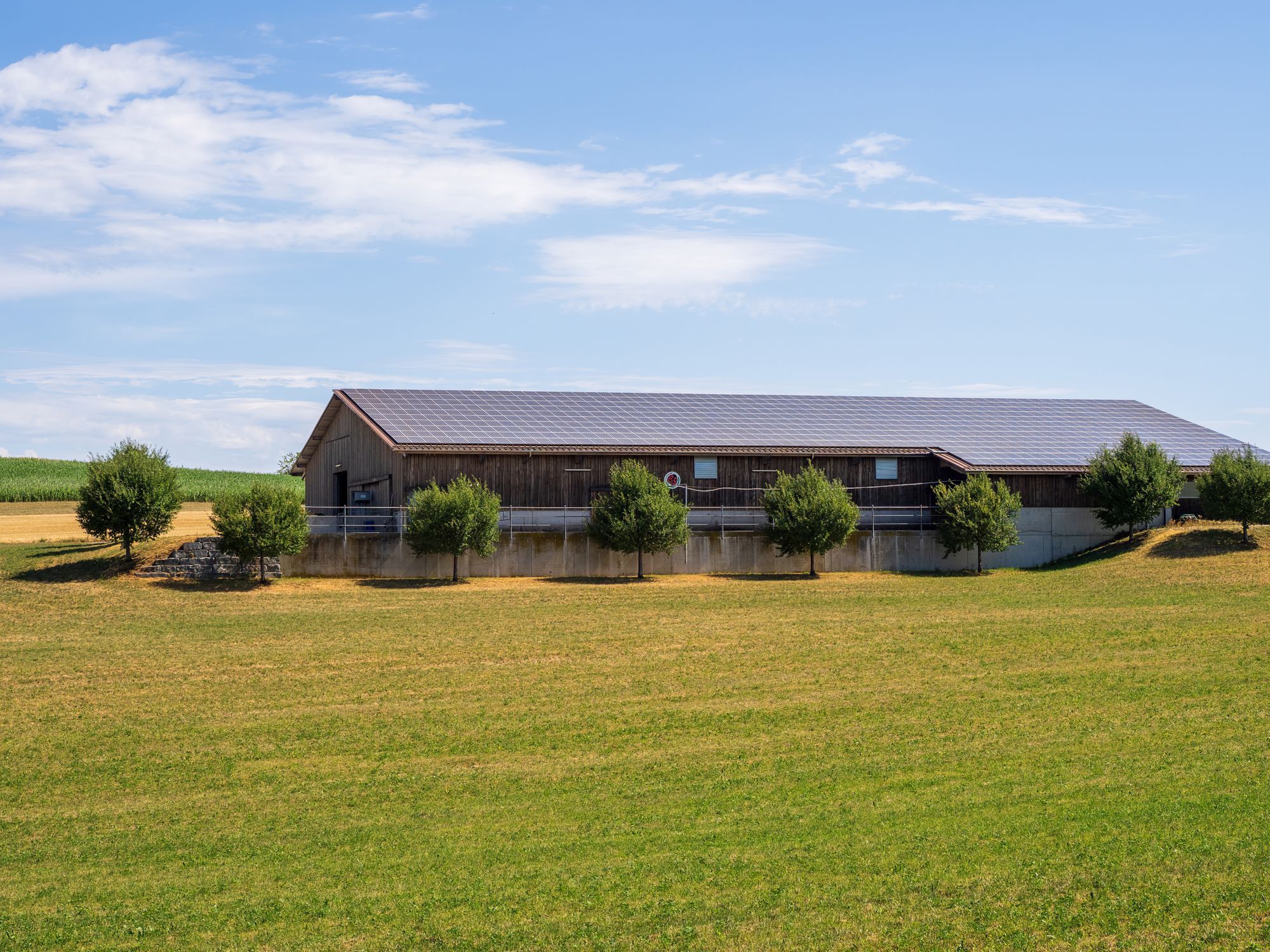
Barns, sheds and agricultural buildings usually have large unused roof space facing the right way. That roof can carry a serious array without using an acre of land.
Put unproductive land to work with a ground mount array, sized around your site and your demand rather than the shape of a roof.
Store daytime generation for evening and night use, and keep essential equipment running through a power cut. We install systems including Sigenergy and the Tesla Powerwall 3.
Charging for farm vehicles, fleet and machinery, tied into your own generation so more of your running costs stay on site.
Rural properties have the two things solar needs most: space and demand.
Solar pays back fastest when it runs the things you already use in daylight. That is why our survey starts with your loads, not just your roof.
Morning and evening milking, the vacuum pump, the bulk tank and hot water for washdown. Panels cover the daytime cooling, and a battery charged in the afternoon carries the evening milking.
Drying runs hardest in late summer, when panels are producing the most. Fans, augers and conveyors on a three phase supply are a strong match for a large roof array.
Ventilation, lighting, heating and feed systems that run all day, every day. Steady daytime demand means more of what you generate is used on the farm rather than exported.
Chillers, freezers, lighting and tills that cannot go off. Battery storage with backup keeps the essentials running through a power cut.
Welders, compressors, pressure washers and tools on three phase, plus charging for electric vehicles and machinery as you add them to the fleet.
Borehole pumps, trough supplies and irrigation that can be scheduled for the middle of the day, when the roof is doing the work.

Not every farm needs a big battery on day one. With a Sigenergy system the energy controller goes in with your panels, and battery modules slot onto the same stack later, once a season of real figures shows how much storage is worth having.
We are a registered Sigenergy installer, and we size every system from your own usage.
Specifications from Sigenergy’s UK range. The exact controller, battery size and backup setup are confirmed at survey.
Many older farm buildings have asbestos cement or fragile roof sheets. We never fix to them or walk on them unchecked. The survey tells you whether the roof can carry panels, or whether re-sheeting first makes more sense.
Systems up to 16 amps per phase connect under G98 with a notice to the network operator. Most farm systems are bigger and need a G99 application, which takes longer and can come with an export limit. We find out early, because it shapes the design.
A three phase supply can take far more generation and suits farm machinery. On single phase, we tell you what that limits and whether asking the network operator for an upgrade is worth it.
In England, panels on the roof of a farm building are normally permitted development, with no size cap since December 2023. Arrays over 50 kW need the council’s prior approval on design and glare, listed buildings need full permission, and most ground mounts need planning. Wales and Scotland have their own rules.
Larger electricity suppliers must offer a Smart Export Guarantee tariff for systems up to 5 MW. For systems up to 50 kW, suppliers ask for MCS certification, which covers our solar PV and battery work. Bigger systems follow a different evidence route, and we set that out in the design.
Many farm businesses can claim capital allowances on solar and battery equipment. Your accountant can confirm how it applies to you, and we give you the generation and savings figures they will ask for.
We work through all of it as part of the survey and design. No guesswork, and no promises we cannot stand behind.
Two rural case studies are being written up now. We publish the real figures once the systems have run through a season, so what you read here is what actually happened.
It depends on the roof area, its pitch and condition, and what the grid connection allows. A large portal frame shed can often take a far bigger array than a house. We size it to your daytime demand first, then look at whether export makes extra panels worth it.
Panels can cover a good share of the daytime load, such as milk cooling, and a battery charged during the day can carry the evening milking. How much depends on the herd, the equipment and the season, which is why we look at your actual usage before quoting.
In England, roof mounted panels on farm buildings are usually permitted development. Systems over 50 kW need prior approval from the council on design and glare, and listed buildings and most ground mounts need full planning permission. We check your site as part of the survey.
Yes. With a modular system such as Sigenergy, the energy controller goes in with the panels and battery modules can be added to the same stack later, so you can start with solar and grow into storage.
Solar on its own switches off when the grid fails, to keep anyone working on the lines safe. With a battery and backup set up, chosen circuits keep running. We agree with you which ones matter most, such as cooling, ventilation or water.
Asbestos cement sheets are fragile and must not be drilled or walked on without the right controls. We assess the roof at survey and tell you straight whether to re-sheet first, use another building or look at a ground mount.
Yes, through a Smart Export Guarantee tariff, which larger suppliers must offer for systems up to 5 MW. You can choose any supplier that offers one, and it does not have to be the company that supplies your electricity.
Lancaster City Council has approved a solar canopy, a battery and eight rapid chargers on the Auction Mart car park. We're not involved, but the design decisions in the planning file are worth learning from, at home and at work.
Fitted between 2011 and 2019 with no storage? Your roof has been giving most of it away. Whether you can add a battery is a narrower question than people assume.
Tell us about your site and we will come and look at it properly, then design around what you actually need. No obligation.
01200 407790