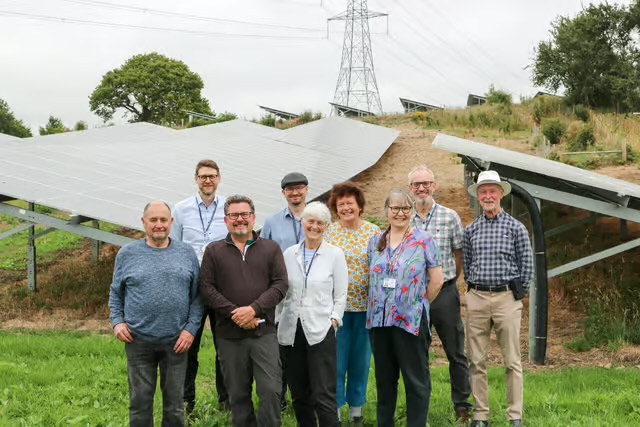

Pictured above: ground-mounted solar near Lancaster. The Auction Mart hub itself has not yet been built; the drawings are in the planning file linked at the end.
On 1 September 2026, Lancaster City Council’s planning committee unanimously approved a solar-powered electric vehicle charging hub on the Auction Mart car park on Thurnham Street, in the middle of the city. Eight rapid charging bays under a solar canopy, with a battery, solar-powered lighting, and the ability to export what it does not use back to the grid. Construction is expected to start later this year and the hub should be open during 2027.
Press releases about projects like this usually stop at the headline. The planning file is more interesting, because it shows the choices a competent team made and why. We have gone through it so you do not have to.
How it is designed to work
Three components do the work: a solar canopy over the parking bays, a battery energy storage system, and the chargers themselves. The canopy generates during the day. The battery banks what is not needed immediately. The chargers draw from the battery and the panels first, and the site’s own lighting runs off the same supply. Anything left over is exported. That ordering — generate, store, use, then export — is exactly the ordering that makes solar pay, at any scale.
Five decisions worth copying
Tap each one to open it. Under every decision we have put what it means at home and what it means for a business, because the logic is the same; only the numbers change.
+They chose matte, anti-glare panels — and proved it
What the council did. The specification in the planning file is for Eurener “Nexa Matte” modules, and the application includes a dedicated solar glint and glare study. This is a town-centre site with roads, neighbours and the Lancaster Canal nearby; the council did not leave reflection to chance.
Why it matters. Reflection is the objection that sinks more solar applications than any other, and it is the one most installers never mention. A matte panel and a study that shows where the sun will bounce turn a likely objection into a non-issue before anyone raises it.
+A battery, not just panels
What the council did. The scheme includes a battery energy storage system. Without it, the chargers would only be “solar-powered” at the moments the sun happened to be out and a car happened to be plugged in.
Why it matters. Solar generates when the sun says so; people charge when they need to. A battery is what turns a generation curve into a service. It is also what lets the council promise cheaper charging when the panels have already done the work.
+The tariff is designed around the sunshine
What the council did. The council has committed to discounted rates for residents and taxi drivers, including “Solar Saver Sessions” that offer extra savings at times when there is surplus renewable energy available.
Why it matters. This is demand shaping, and it is clever. Instead of the battery absorbing all the surplus, the tariff nudges drivers to charge when the sun is generating, which makes the whole system cheaper to run and cheaper to build.
+It is built for people who cannot charge at home
What the council did. The council’s stated reason for a central public hub is access. In the words of Councillor Sam Riches, cabinet member for climate action: “Nearly half of households across the district do not have access to off-street parking, making it more difficult and expensive for many people to switch to an electric vehicle.” The council’s own plan names the higher cost of public charging as the other barrier.
Why it matters. This is the honest framing most EV conversations miss. Public rapid charging is essential infrastructure for the half of households without a drive. It is not the best option for the half who have one.
+It respects a sensitive setting
What the council did. The site sits in the centre of a historic city, and the planning file carries a conservation consultee response, a Canal and River Trust response and a ground investigation. Lancaster’s city-centre conservation area also carries an Article 4 Direction, which removes many of the usual permitted development rights.
Why it matters. A canopy in a conservation area is exactly the kind of proposal that gets refused when it is designed without regard to its surroundings. This one was approved unanimously, which tells you the consultation was done properly and early.
Our commercial team designs, installs and maintains solar and storage for businesses, public bodies and housing providers, and will tell you honestly whether a site stacks up.
The same three parts, at three scales
| Component | The Lancaster hub | Your home | Your business |
|---|---|---|---|
| Generation | Solar canopy over the bays | Roof array, sized to the roof and the household | Roof, canopy or ground array, sized to the load profile |
| Storage | Battery energy storage system | Home battery, sized to your evenings | Battery for peak-shaving and resilience |
| Use | 8 rapid chargers, site lighting | The house, then the car | Operations, then fleet or customer charging |
| Surplus | Exported to the grid | Exported on a smart export tariff | Exported, or sold on to tenants and users |
| What decides success | Steering demand into sunny hours | Orientation, shading, when you are home | Matching the array to the load, not the roof |
What it means for you
We say this on every page of our site and it applies here too: the county you are in matters far less than what shades the roof, which way it faces, and when the building is occupied. The council’s team clearly understood that. The hub is designed around how people actually charge, not around the panels.
Car park, roof or canopy
If you have a roof, a car park or a fleet, the same three-part design applies to you. We design commercial solar and storage around your load profile, your planning setting and, where it fits, EV charging for staff and customers.
Talk to us about commercial solarGot a driveway? Charge from your roof
Panels, a battery and a charger sized together mean a good share of your driving runs on your own roof. We cover Lancaster, Morecambe and the Lune valley, and we survey every roof in person before we quote.
Get a free home assessmentSources
- Lancaster City Council: Plans approved for solar-powered EV charging hub
- Planning application 26/00726/FUL, Auction Mart Car Park, Thurnham Street, Lancaster — documents including the Design and Access Statement, Solar Photovoltaic Glint and Glare Study, Eurener Nexa Matte specification and consultee responses
Facts above are taken from those two sources. Where the release did not give a figure — the size of the array, the battery capacity, the cost — we have not guessed one.
Miles has led retrofit programmes at scale across the UK, with long-standing relationships with local authorities including Kirklees Council, Durham County Council and Ribble Valley Borough Council. He has project-directed programmes for housing associations and delivery partners including Sureserve, LivGreen and BroadOak, and for energy suppliers including E.ON Next, Utilita, British Gas, Octopus and UKEM.